For years, many property owners and managers avoided testing site lighting poles under the belief that less information meant less liability. Insurance data, claim outcomes, and real world loss scenarios prove the opposite.
The Initial Assumption Was Wrong
Historically, there was a belief that property managers were better off not knowing the condition of their light poles. The logic was simple. If you do not test, you cannot be held accountable for what you do not know.
In practice, lack of knowledge does not remove liability. It often makes claims harder to defend. When an incident occurs, the absence of inspection records is commonly interpreted as a lack of maintenance, not a lack of awareness.
Insurance Carriers Focus on Infrastructure Age and Maintenance
When a pole fails, insurance carriers almost always review the age of the infrastructure and the maintenance history. Aging poles without a documented inspection program are frequently flagged as deferred maintenance.
Deferred maintenance does not equal automatic insurability. Claims are often denied when pole age is high and no testing or inspection records exist.
Visible Damage Without Action Increases Risk
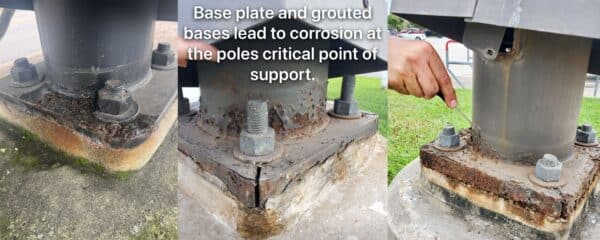
Many properties show visible pole deterioration long before ultrasonic testing is performed. Rust at the base, flaking steel, cracking, or corrosion are common indicators.
When visible damage exists and no inspection or corrective action is documented, it demonstrates a lack of maintenance. This significantly weakens any insurance claim and often shifts full responsibility back to the property owner.
Testing Creates a Documented Burden of Proof
A formal ultrasonic pole testing program demonstrates proactive infrastructure management. The act of testing itself establishes due diligence.
Documented testing shifts the burden of proof away from the property owner and toward the condition data. This materially improves the likelihood that insurance claims are processed and approved.
Learn more about how ultrasonic testing works and what it uncovers here:
Ultrasonic Pole Testing Services
Risk Mitigation Extends Beyond Pole Failure
The risk is not limited to a pole falling. Liability includes what the pole strikes, vehicles, people, structures, and adjacent property.
Many large portfolios are partially or fully self insured. In these cases, preventing failure is often more critical than transferring risk through insurance.
Testing Reduces Total Financial Exposure
Ultrasonic pole testing mitigates catastrophic loss and secondary liability. The cost of testing is minor compared to capital outlays from failure related claims, lawsuits, emergency repairs, and site remediation.
Planned, predictable, and budgetable.
Unplanned capital expense, legal exposure, and potential injury claims.
Opportunity to Shift or Recover Testing Costs
For larger portfolios, there is often a path to position pole testing as an insurable or reimbursable expense. Federal claim data and loss figures consistently show that prevention costs are dramatically lower than failure losses.
When framed correctly, testing becomes a cost avoidance strategy rather than an added expense.
Bottom Line
- Knowing pole condition reduces risk. It does not increase it.
- Testing protects ownership, strengthens insurance position, and limits downstream liability.
- The cost of testing is insignificant compared to the cost of failure.
Ready to Evaluate Your Site Risk?
If you want to understand pole condition, risk exposure, or how to implement a testing program across your portfolio, our team can help.